
The short answer is that there’s no single official formula, and anyone who tells you otherwise is oversimplifying. The most widely used method treats the first year of a cat’s life as roughly 15 human years, the second as another 9, and every year after that as about 4. That gives you a fast, practical way to convert cat age to human years without a calculator app, and it lines up well with how veterinarians actually think about feline aging.
Key Takeaways
- Year one equals about 15 human years; year two adds about 9 more, putting a two-year-old cat near 24.
- After age two, add roughly 4 human years for every cat year.
- The formula is a rough estimate, not a biological measurement — breed, size, and lifestyle shift it.
- Indoor cats typically live 12 to 18 years, which maps to roughly 64 to 88 on this scale.
- Life stage matters more than the number: kitten, young adult, mature, senior, and geriatric each need different care.
- Your vet’s physical exam and lab work tell you more about your cat’s real age than any chart.
Why Cat Years Aren’t Simply Multiplied by Seven
The “multiply by seven” rule is a folk shortcut with no veterinary basis. It probably spread because both cats and humans were said to live about 70 years, so someone divided one by the other. The problem is that cats mature far faster in their first two years than a straight-line multiplier allows, then slow down relative to humans later in life.
A one-year-old cat can already reproduce. A seven-year-old human cannot. That single fact shows the seven-times rule breaks down immediately at the start of life. The two-stage formula — fast early, slower later — matches what vets actually observe in growth plates, dental wear, and organ function.
The Practical Formula, Step by Step
Here is the method most veterinary references use, and it takes about ten seconds.
Step 1: Is your cat under one year?
Use 15 human years for the first birthday. A six-month-old kitten is roughly 10 human years on a proportional basis, because most of that first-year growth happens early.
Step 2: Is your cat one or two years old?
A one-year-old cat is about 15. A two-year-old cat is about 24. That second year adds nine years, not fifteen, because the growth spurt has ended.
Step 3: Is your cat older than two?
Take your cat’s age, subtract two, multiply by four, then add 24.
Example: A 10-year-old cat. 10 − 2 = 8. 8 × 4 = 32. 32 + 24 = 56 human years.
Step 4: Round and interpret
Round to the nearest whole number, then read it against a life-stage chart rather than treating it as a precise biological age.
Quick Conversion Table
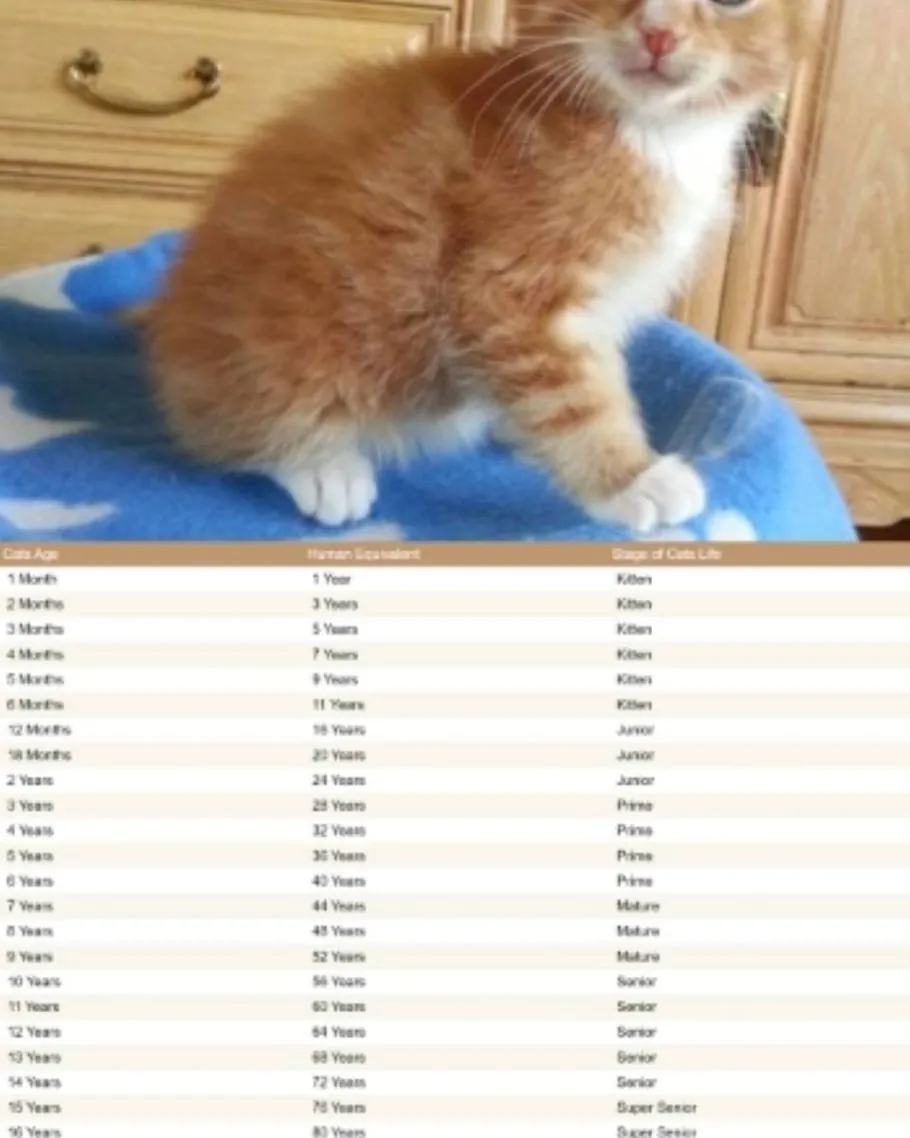
| Cat Age | Human Years (estimate) | Life Stage |
|---|---|---|
| 6 months | ~10 | Kitten |
| 1 year | ~15 | Junior |
| 2 years | ~24 | Young adult |
| 5 years | ~36 | Adult |
| 8 years | ~48 | Mature |
| 11 years | ~60 | Senior |
| 14 years | ~72 | Senior |
| 18 years | ~88 | Geriatric |
If your cat’s number falls between rows, interpolate — the scale is continuous, not stepped.
What Actually Changes the Number

The formula assumes an average domestic cat. Several real factors push the estimate up or down.
- Breed: Siamese and other Asian breeds often live longer; Maine Coons and Persians tend toward shorter lifespans.
- Body size: Larger cats generally age faster, the same pattern seen in dogs.
- Indoor vs. outdoor: Indoor-only cats avoid traffic, fights, and infectious disease, which is the single biggest lifespan factor.
- Dental health: Periodontal disease is extremely common in cats and correlates with systemic problems.
- Weight: Obesity raises the risk of diabetes and joint disease, effectively aging the body faster.
- Neuter status: Neutered cats tend to live longer, largely because they roam and fight less.
Pro Tip: If you want a realistic estimate rather than a flattering one, adjust the formula down for a large-breed outdoor cat and up for a small indoor breed with good vet care.
Life Stages Matter More Than the Number
Knowing your cat is “56 in human years” is interesting. Knowing it’s a senior is actionable. Life stage drives what you actually do.
Kitten (0–1 year)
Rapid growth, vaccination series, socialization, and multiple small meals daily. This is when preventive care pays off most.
Young adult (1–6 years)
Peak physical condition. Focus on weight management, dental care, and annual exams.
Mature (7–10 years)
Early signs of kidney, thyroid, and joint changes appear. Many vets move to twice-yearly exams here.
Senior (11–14 years)
Bloodwork becomes important. Watch for weight loss, increased thirst, and behavior changes.
Geriatric (15+ years)
Comfort-focused care: soft bedding, easy litter box access, warmth, and prompt treatment of any pain.
When the Formula Gets It Wrong
The math is a population average. Individual cats can be years off it in either direction.
A 15-year-old cat that still jumps onto counters and maintains muscle is biologically younger than its number suggests. A 9-year-old cat with chronic kidney disease may be functionally older. Body condition score, muscle mass, coat quality, and activity level are better real-world indicators than arithmetic.
Warning: Don’t use this formula to decide whether your cat needs veterinary care. A cat is a senior at seven by most veterinary definitions, regardless of what the human-year conversion says.
How Vets Actually Estimate Age
When a stray cat arrives with no history, veterinarians estimate age from physical clues rather than a formula.
- Teeth: Eruption timing in kittens is precise; wear, tartar, and missing teeth suggest age in adults.
- Eyes: Lens clouding and iris changes progress with age.
- Coat: Graying, dullness, and reduced grooming appear in older cats.
- Muscle and bone: Spine feel and muscle wasting over the shoulder blades are useful markers.
- Organs: Blood and urine values give functional age information no chart can.
The American Veterinary Medical Association notes that cats are generally considered senior starting around age seven, which is why it recommends more frequent wellness exams from that point on.
A Simple Care Schedule by Age
| Cat Age | Human Equivalent | Vet Visits | Key Focus |
|---|---|---|---|
| 0–1 | 0–15 | Every 3–4 weeks until 16 weeks, then annual | Vaccines, deworming, spay/neuter |
| 1–6 | 15–36 | Annual | Weight, dental, parasite prevention |
| 7–10 | 44–56 | Every 6–12 months | Bloodwork, thyroid, kidneys |
| 11–14 | 60–72 | Every 6 months | Pain management, dental, senior panel |
| 15+ | 76+ | Every 6 months or as advised | Comfort, hydration, quality of life |
Common Mistakes to Avoid
- Using the times-seven rule. It overestimates young cats and underestimates old ones.
- Treating the result as exact. It’s an estimate with a wide margin.
- Ignoring life stage. The number is trivia; the stage is the plan.
- Skipping senior bloodwork. Many feline diseases are silent until advanced.
- Assuming a thin old cat is just old. Weight loss in senior cats is a symptom, not normal aging.
Frequently Asked Questions
How do I convert my cat’s age to human years quickly?
Double the first year to 15, add 9 for the second year, then add 4 for each year after. A 6-year-old cat lands at roughly 40 human years. It’s a fast estimate, not a medical measurement.
Is the 7-year rule for cats accurate?
No. It fails badly at both ends. Cats mature far faster than seven-to-one in their first two years and slower than seven-to-one in old age. The two-stage formula tracks real development much better.
What is 15 in cat years?
A 15-year-old cat is roughly 76 human years on this scale. That places it firmly in the geriatric stage, where twice-yearly vet visits and comfort-focused care are standard.
Do indoor cats age slower than outdoor cats?
They age at the same biological rate but typically live longer, because they avoid cars, fights, and infectious disease. That means they reach the same life stages later in calendar years.
At what age is a cat considered senior?
Most veterinary organizations put senior status at around seven years, which is roughly 44 human years. Some cats show senior changes earlier; large breeds often do.
Can a cat live to 30?
Rarely, but it happens. The oldest verified cats have reached their late twenties and beyond, which maps to over 100 human years on this scale. Good genetics and consistent care both matter.
Where to Go From Here
The conversion is a conversation starter, not a diagnosis. The genuinely useful move is to take your cat’s human-year estimate, find its life stage in the table above, and act on that row. If your cat is seven or older and hasn’t had bloodwork in the past year, that’s your next step — call your vet and book a senior wellness panel. It’s the single highest-value thing you can do with this number.
